Tuesday, 23 June 2015

You stuck the ring where???

Well the weather of late seems most un-June like, yet the wildlife doesn't seem to mind too much as things are carrying on pretty much as normal at Lackford. This includes the kingfishers at Hawker pool which have now fledged and can be seen on various parts of the reserve.

Newly fledged kingfishers by Joe Jackson on Twitter (@EyesOnWildlife)
Our regular visitor and contributor to the blog Ian Goodall also managed to get some shots of one of the adults visiting and leaving the nest hole shortly before the young fledged.

Adult visiting with food. Note how the fish's head is pointed outwards so the young take it the right way.

Young fed, off to find some more.
Shawn Pearce even got a good shot which he also shared on Twitter (@spearcephotos)

Kingfisher in action by Shawn Pearce

Big thanks to everyone for sharing their fantastic photos, really appreciated.

You put the ring where???

A very unusual photo appeared on Twitter via Rich Berry this week, of an unusually ringed bird.

Ringed Greylag 'FJH' by Rich Berry
After a little digging we were able to find out more about this bird via the person responsible for ringing it, Lee Barber, Recoveries officer at BTO Thetford. Lee emailed us to say:

The bird you have seen are part of a monitoring program with the aim of finding out where Greylag and Canada Geese move to after they have been ringed and neck collared during their annual moult. I have attached a poster that gives a bit more detail into this project.  The bird you saw was an adult male ringed at BTO HQ, Thetford in 2014. This bird has been interesting as it has not been seen away from the BTO since being ringed and hasn't been reported for some time. The age code 4 means that it hatched before the current calendar year when it was ringed. The age code 2 means it was seen as a fully grown bird (i.e. not a chick). It is good to hear this bird is still going strong... 

Lee also sent us the recapture history for FJH:

FJH's recapture history 

At first when we began digging, it was thought that FJH was part of an Icelandic ringing project. However, as we can see, FJH comes from much closer to home. But still an interesting find and if you see anything like this at Lackford, please let us know so that we can inform others. Big thank you to Rich for sharing this photo and well done for spotting FJH.

What's the point of nettles?

Let's face it, nettles are not everyone's idea of a garden plant. No-one actually plants nettles in their garden, yet they are a very important plant in our ecosystem as Rich Berry proved with this photo taken last week on the reserve.

Nibbly caterpillars enjoying the nettles.
Yes, these caterpillars love nettles and we love the caterpillars, especially as these are the caterpillars of the beautiful peacock butterfly. One to keep an eye out for when you visit Lackford.

Another one to watch out for at Lackford are our beautiful bee orchids. These can be seen along the path leading from the centre to Bernard's hide. East Anglian columnist Nicola Miller shared her photo of the bee orchids on Twitter:

Bee orchid by Nicola Miller (@NicMillersTale)

Sightings

Well as we already know, the kingfishers are showing very well and after weeks of only being seen at Hawker Pool, they can now be seen across the reserve with sightings coming in from Double-decker, Bernard's and Reed hides.

Raptors are also showing well with daily sightings of red kite, hobby, sparrowhawk and buzzard over the reserve.

Adrian Sheppard spotted this water rail yesterday at Reed hide.

Water rail by Adrian Sheppard
The great crested grebe and their chicks can still be seen from Bess' hide and the red crested pochard still has three chicks and can be often seen at Fuller's Mill hide. Shelduck's still have seven chicks and can be seen from Bill's hide. There was a touch of drama today at the centre when a female mallard brought her chicks to the centre pond and abandoned them! She flew off shortly after arriving with the chicks, which left the onlooking visitors feeling a bit anxious and worried. But thankfully, after about 20 minutes, she returned and calm was restored to the centre.

The butterflies and dragonflies are showing up well at the reserve with sightings of meadow brown, ringlet, painted lady and large skipper and emperor dragonflies also being spotted on the reserve. The best place to see these are on the summer trail and the path towards Bernard's hide.

Tony and Sandy (@tonyandsandy) had a very productive day recording all these beautiful moths at Lackford recently

A wide selection of moths seen at Lackford (left to right: Longhorn moth, silver ground carpet, straw dot, cinnabar moth, clouded border, snout and a geometrid moth)
If you would like to see more moths close up, then don't forget to come along on our Wild for the Weekend on the 4th and 5th July, where we will be displaying some of the moths caught in our traps here at Lackford. This is always a popular event and we will be displaying our moths at 1 pm on each day that weekend. Don't miss out!!!

Don't miss this either!

Our new provider of optical equipment, Viking, will be at Lackford this weekend (27th June) to demonstrate their range of optics. If you think you deserve a new pair of binoculars or are thinking of getting a scope perhaps, or even just want to peruse and try some out, then come on down between 10am - 4pm in the visitor centre.


Tuesday, 9 June 2015

Kingfishers and dragonflies.

Two new arrivals this week and they weren’t chicks. The first was a pair of avocets which landed near Steggall’s hide. Unfortunately, they weren’t there for long and were soon off, later being spotted at another SWT reserve, Mickle Mere. The other new arrival was the spotted flycatcher, which unlike the avocet’s, should stay a lot longer. So these two new birds brings the reserve bird species list up to 130 for the year. 

The turtle dove has started to be seen again on the overhead wires as you drive into the car park. The best times to see these are early in the morning though. Although, there have been some daytime sightings in the adjacent fields.

The reserves team of volunteers had a bit of a clear out in front of Reed hide recently removing some of the encroaching reed bed. This seems to have had a positive effect, as hoped, as reed warblers have been showing well and also young kingfishers have been spotted there since. The young kingfishers are not the ones from Hawker pool though. These are young believed to be from a nest on the adjacent River Lark that have fledged earlier. The kingfishers at Hawker pool are still feeding their young and it’s believed they should fledge sometime this week, one to keep an eye on.

Juvenile Kingfisher with food at Reed hide © Duncan Fletcher-Brown

And in flight © Duncan Fletcher-Brown

Common terns have now hatched their young and can be seen on Hawker pool and tufted ducks have also been spotted with no loess than 6 chicks and can be seen from Steggall’s hide. Great crested grebes also have young riding on the adults back and can often be viewed from Bess’ hide.

The once famous stars of the Lackford stump, the nuthatch’s, have thought to have fledged their young, yet no-one has seen them yet. Another one to keep an eye out for. 

Strangely, in the middle of the night, the coots at the visitor centre pool, built a new nest on one of the floating islands and their last remaining chick has taken to sitting in the middle of it.
Coot with young in the middle of the new nest.

On the insect front

Things have been perking up on the insect front too and the butterflies seem to becoming out in force now with brown argus, peacock, brimstone, red admiral and common blue among others being spotted.

Male common blue © Rich Berry
Cinnabar moths can still be seen fluttering around the reserve and it won’t be long before their black and yellow caterpillars will be seen munching on the ragwort around the reserve.

Dragonflies are being seen in numbers now and the first black-tailed skimmer was spotted on the reserve at the weekend Damselflies have also been seen emerging from the water down at Orchid hide and are very numerous wherever you go on the reserve.

Dragonflies a plenty © Rich Berry
One damselfly that’s always a sight to see is the banded demoiselle and as usual, these can usually be seen from the bridge just before Bess’ hide. As always, pop into the visitor centre when you arrive to find out what is happening where on the reserve.

© Rich Berry

Monday, 1 June 2015

Every little helps

Well last weekend was our themed weekend Things with Wings. Being a Bank Holiday as well, the reserve saw plenty of visitors, many of whom also came to see what had been caught in our moth trap overnight. The moths caught included poplar hawkmoth, white ermine, cockchafers and many more.

A fresh looking White Ermine moth

Poplar hawkmoth hangs onto a Cockchafer for support.

Yellow Belle, a Breckland species.
The visitors were amazed at the different varieties that we caught and some were even brave enough to hold them.

Getting to know a Billywitch

Poplar hawkmoth wows those looking on.
Due to the success of the moths, we may be holding moth trapping days more often, so watch this space.

The weekend also saw us hold our first bat walk on the reserve. Thankfully the weather held out and the bats enthralled all those who attended the walk. We saw and heard several species on the bat detectors including pipistrelle’s, noctule’s and daubenton’s to name a few. Look out for more of these bat walks in the future.

Every little helps

As many of you know, there are many people who help out at Lackford by donating their time, whether it is in the visitor centre or out on the reserve. One group that help out are the Young Wardens. Last week they got busy out on the reserve helping to clear some willow to create a dragonfly viewing point for visitors to the reserve. They also helped by filling the new tree nursery with some saplings and planting some saplings out on another part of the reserve.

Maria gets ready to plant some new saplings in the tree nursery.

A sapling planted out on the reserve.
A big thanks to the Young Wardens, your work has not gone unnoticed. If you are 10-15 and would like to join the Young Wardens, then click here for more details.

If you would like to help out in the visitor centre, we are still seeking some bubbly, confident volunteers to help out on Sunday’s, Monday’s (during summer period) and Tuesday’s. See here for more details.

Plants for sale

We have had a fresh delivery of plants with a big thanks to all those who have donated them to us. Please feel free to pop along and have a browse, all we ask for is a donation and all proceeds goes towards the Trust.

Give a plant a home in your garden.

Sightings

The past week has seen the kingfishers showing well and now their young have hatched, they will be seen more often as the busy task of feeding the chicks gets underway. Many of the smaller birds such as the tits and warblers will have had their young fledge by now, so keep an eye out on the reserve as the parents still feed their young, but out in the open now.

Kingfisher approaches with food.

Red crested pochard still have 3 young down at Fullers mill hide and the shelduck still have 7 young on the Slough.

Birds of prey are still to been seen with hobby’s around the visitor centre and sailing lake. There have been more sightings of late of red kite and other birds visible this week were buzzard’s, kestrel and sparrowhawk.

Swifts have been plentiful, especially when the wind picks up, and so have house and sand martin’s. Great crested grebes are nesting down on the east lakes. This is also a good area for the dragonfly spotters amongst you. Recent and regular visitors Tony and Sandy (@tonyandsandy) recently saw and photographed this unusual looking four-spotted chaser.

Libellula quadrimaculata praenubila form (@tonyandsandy)
This form of dragonfly is known as a praenubila form and can be distinguished by the extra darkening of the wing-tips, which isn’t seen in the normal form. It is thought that this darkening is caused by the water temperature whilst the dragonfly is still a larvae. 

A normal looking Four-spotted chaser taken by wildlife guide Colin Robson.

Hairy and broad-bodied chaser’s  have been seen flying around the reserve and red-eyed, common blue, azure and banded demoiselle have also been seen in numbers near Bess’ hide.

Red-eyed damselfly by @tonyandsandy
Butterflies are also being spotted around the reserve. This weeks sightings include brown argus, red admiral, small copper, peacock, brimstone, speckled wood, comma and still the occasional orange-tip.

Tuesday, 19 May 2015

All things small.

Well what a week it’s been at Lackford, with lots of new arrivals to be seen. A common sight this week has been lots of ducklings and goslings wandering around with their very protective parents keeping an ever watchful eye over their precious young. One of these new families was our only pair of red crested pochard’s who were spotted swimming around happily showing off their new additions.

Red crested pochard and young.
Ben Alder managed to capture this shot of the Canadian geese and their young down near Ash Carr and posted it to our Facebook page.

Lackford lakes is ideal for families © Ben Alder
A little bit further afield and harder to see are the chicks of the shelduck’s, but it’s still worth trying to get a peek if you can and the best place for this is either at Bill’s hide or the double-decker hide looking arose to the Slough.

Shelduck’s and young
We also have several great crested grebe’s nesting around the reserve and the best place to see this is at Bess’ hide where 2-3 nests can be seen, one of which is almost in front of the hide. It won’t be long now before we begin to start seeing the grebe chicks, fingers crossed.

Great crested grebe on nest outside Bess’ hide.
If you go to our Youtube channel, you can see the above grebe doing some bond affirming head shaking.


Moorhhen’s and coot’s  are also hatching chicks on the reserve at the moment and some of these are actually visible on the visitor centre pond. However, here is a clip from Reed hide taken earlier this week.


Of course, it’s not just about the waterfowl. Josephine Sweetman visited Lackford recently and her sharp eye managed to capture these superbly camouflaged treecreepers.

Newly fledged treecreepers © Josephine Sweetman

Such amazing camouflage © Josephine Sweetman
As the weeks progress, we are bound to see many more fledglings around the reserve and we look forward to seeing your photos of them. If you are lucky enough to capture these in the viewfinder of your camera and want to share it with us, then please send it as a .jpg file to lackford.centre@suffolkwildlifetrust.org where we will do our best to feature it in the blog. Or you could share it to our Facebook or Twitter (@SWTLackfordLake). We look forward to seeing your photos as do many of our expanding army of followers.

Sarah Steggall emailed us her photos from her visit this week. Sarah was lucky enough to capture another two new arrivals, banded demoiselle and red-eyed damselfly.

A male banded demoiselle © Sarah Steggall

Red-eyed damselfly © Sarah Steggall
Dragonflies and damselflies can be seen in most places around the reserve as was the case earlier this week when several were ticked off our ‘Return of the Dragons’ list, which can be seen in the centre.

Busy as a bee!

This time of year sees a lot of bees buzzing around the reserve, only a couple of weeks ago, a swarm of honeybees escaped from a hive on an adjacent property and spent the night sleeping on a fencepost on a non-public part of the reserve.
Honeybees resting on a post.
Not a lot of people realise this, but in the UK, there are around 250 species of bee. 24 are bumblebees, 1 species of honeybee and the rest are known as solitary bees. These are small bees that do not live in social groups like honeybees and bumblebees. Instead, they create their own burrow, or find a previously created burrow and fill it with pollen and an egg before sealing it up to allow it to develop over the winter before hatching the following year to begin the process all over again.

Some of these bees can be found on the reserve and they are usually much smaller than honeybees. One of these species of bee that has already been found this year on the reserve is the two-coloured mason bee (Osmia bicolor). This bee is rather special in that it lays its eggs inside empty snail shells before filling the shell with small gravel and then it goes off to collect bits of straw and grass to build a teepee around the shell to help camouflage it.

Then there are leaf cutter bees that find old holes in wood or even the holes in bamboo canes that many people have in bug boxes inter gardens. These bees do the same thing but create a chamber inside the hole out of very carefully cut pieces of leaves, before laying an egg in the hole and filling it with pollen and then sealing the chamber with another perfectly cut piece of leaf.

Some bees are tiny, so tiny that they will build their nest chambers inside holes left by nails removed from timbers.

A tiny (7mm) mining bee.
Some bees to keep an eye out for on the reserve are tawny mining bees, early mining bees and chocolate mining bees.

Chocolate mining bee

Early mining bee

Brown carder bee
A mining bee seals off a chamber in a bamboo cane.
Some of these bees are not mining bees, for just like in the bird world there are cuckoo bees! These bees are kleptoparasites of mining bees and do not build nests or chambers for their young. Instead, they look for the nest holes of other bees and when the host bee is away, they sneak in and lay an egg. This egg will hatch before the egg of the mining bee and will eat all the provisions stored for its original host. Cuckoo bees even exist in bumblebee species, where a similar looking in appearance queen bee, will seek out a nest of its host species, sneak in and will kill the host queen, then it forces they worker bees of the host species to rear the young of the cuckoo bee.

If all this talk of bees has whetted your appetite for more, there will be a one day course on mining bees next year at Lackford, details of which can be obtained by phoning 01473 890089.

Wild for the Weekend

This weekend is Wild for the Weekend -Things with Wings. Come down and see what you can find on the reserve. We will have Wildlife guides around the trails to help you spot the things on your spotter sheet and at 1pm, we will be showing the moths that we caught in our traps the night before. 

It’s not only the things that fly in the daytime either, we will be holding a special bat walk on the Saturday (23rd) to hear and see the bats that hunt on the reserve at night. This will start at 9pm and will end around 11pm. This event has limited spaces and BOOKING IS ESSENTIAL. Please phone 01284 728706 to do this, price is £2.50 per person.

Sightings

Turtle dove’s have been spotted and heard on the reserve this week. The best place is on church walk in the early morning or late evening. Nightingale is still singing at the reserve, although not as much as in previous weeks. This week might be the last chance to hear this beautiful song. Hobby’s can still be seen around the sailing lake and over the double-decker hide. Common sandpiper has been spotted from time to time at Steggall’s hide and redshank from Bill’s or double-decker.

Red kites are being seen on a more regular basis at the reserve now and it won’t be long before they are a common sight on the reserve. Hirundines are gathering in large numbers now and often the skies over the reserve are often filled with swifts, swallows and house martins. However, we have yet not been able to coax the swifts into using our swift boxes.

Reed, sedge, garden, willow and cettis warblers can still be heard singing around the reserve, many of these just from the centre car park. Another bird often heard but not seen on the reserve is the cuckoo. This is often heard calling around the sailing lake. Lesser whitethroat and whitethroat can be heard and seen down towards Reed hide and treecreepers and nuthatch’s in Ash Carr. 

Don’t forget to pop into the centre to see the sightings board when you arrive, things move around all the time and it’s worth checking first. Also please pop into the centre to add your sightings to the board regardless of how common you may think it is. We have visitors from across the UK and further afield who don’t see the birds that we get in their regions. 

Stoat was seen to chase and catch a rabbit down at Ash Carr this week as well as still being seen around the visitor centre much to everyones delight. Also spotted this week and causing a commotion for some birds were otters. These were spotted from Bess’ hide and captured on camera by Andy Johnson and share on Twitter (@SWTLackfordLake).

Otter gets mobbed by a black-headed gull © Andy Johnson

Tucking into a tasty crayfish snack © Andy Johnson
A close up shot from © Alan Reynolds

Not the loch ness monster, it’s an otter © Alan Reynolds

Butterflies are still everywhere to be seen and this will be one of the last weeks where you will get to see orange-tip’s as the end of their season approaches.

Don’t forget, we want your sightings, so pop into the centre and let us know, you can even sit down with a nice slice of cake and a cuppa tea whilst you tell us about it. 


Tuesday, 12 May 2015

A welcome return

Yes, a very welcome return this week to the very endangered Red Data Book species. Yes, turtle dove's have been heard and spotted  around the reserve, but only solitary or pairs of birds have been spotted at this stage. 

Another new visitor to the reserve this week is our first dragonfly, which has always been present at the reserve lurking at the bottom of a pond, but has now emerged into adulthood to begin the summer days looking for a partner. A broad-bodied chaser female was spotted and photographed by Tony and Sandy (@tonyandsandy) on twitter.

Broad-bodied chaser by Tony and Sandy
They also managed to capture this beautiful and a first for this year, brown argus butterfly.

Brown argus by Tony and Sandy
Butterflies have been in abundance this week too with still lots of orange-tips, small white, green-veined white, speckled wood, comma and peacocks about. 

Comma by Duncan Fletcher Brown
Another bunch of new arrivals came  in the shape of long-tailed tits and was captured by Terence Chaplin.

5 newly fledged long-tailed tits await for the parents to bring back food. © Terence Chaplin
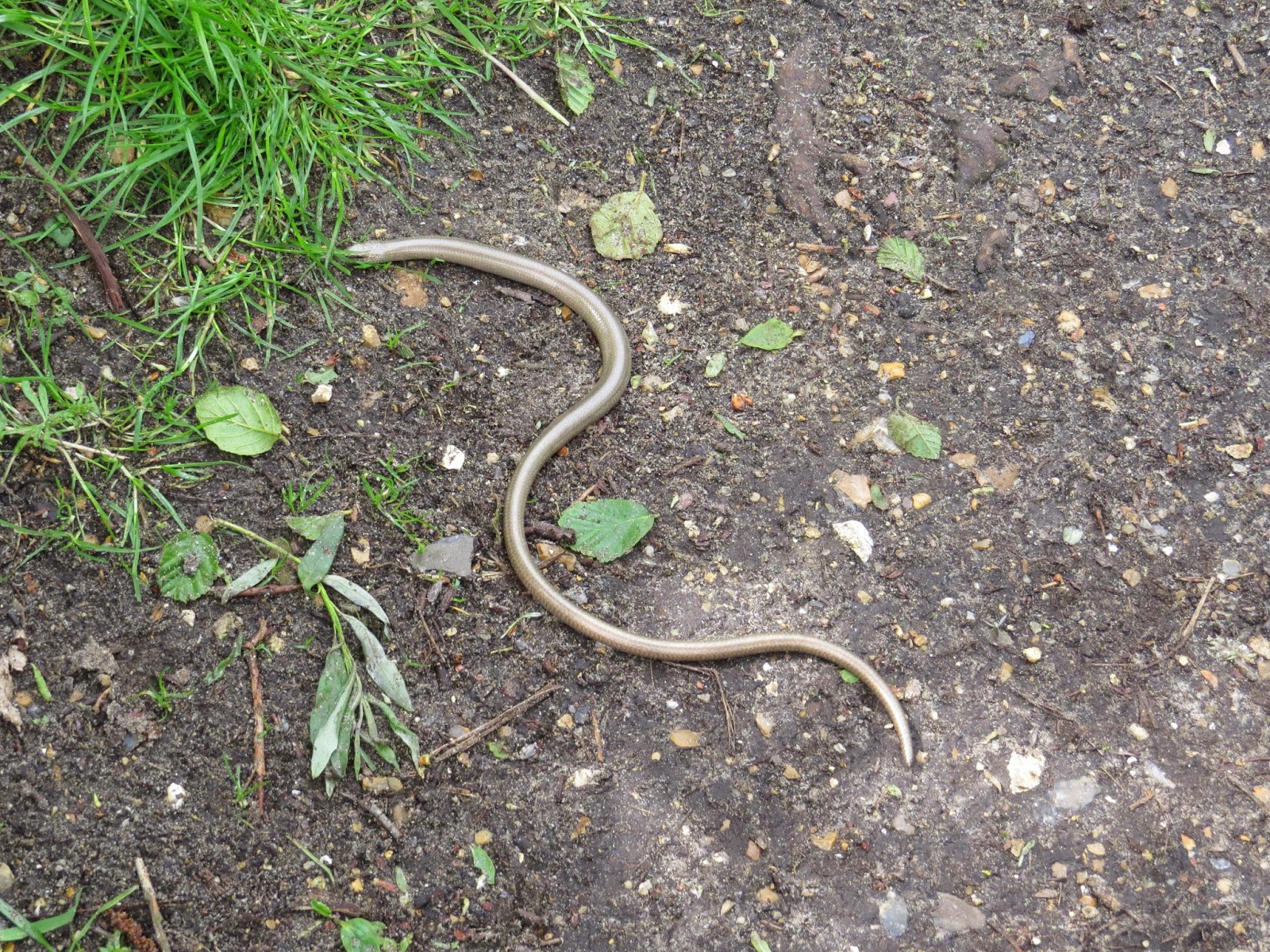
Terence even spotted this slow worm making its way along the path near Reed hide

Slow worm by Terence Chaplin
More damselflies have been spotted on the reserve this week and our wildlife guide Colin Robson managed a photo of a blue-tailed damselfly.

Blue-tailed damselfly by Colin Robson

A grand day out

We had a lovely review this week from a couple of visitors at Lackford, who enjoyed their day so much. they decided to write a blog about it. You can read all about their adventure in their excellent blog here.

Sightings

Well, the sightings are still coming in and there's lots to be seen here at Lackford, as the sightings boards testifies to and the eagle eyed among you will have noticed we are now on 127 species of bird at Lackford.

Sightings board at Lackford
Our newest species to hit the list are a pair of redstart and turtle dove, which we mentioned earlier. Common sandpiper, hobby's, cuckoo and the warbler's (Cettis, garden, reed, sedge, willow, etc) can be seen from all around the reserve, starting in the car park where many are heard when visitors get out of their cars.

Reed warbler by Ian Goodall

Marsh tit with spiders web nesting material by Ian Goodall


Kingfisher's are still nesting down at Hawker pool, although they are often spotted as a blue flash as they dart back and forth from the nest.

Buzzard's, sparrowhawk can be seen from time to time around the reserve and we are getting more sightings of red kites drifting over. This species has made a spectacular recovery since breeding projects began in the late eighties/early nineties and have spread eastwards across the country ever since. So in time, these magnificent birds will soon become a regular sighting at Lackford.

SPECIAL BAT WALK 23RD MAY

As part of our themed Wild for the Weekend -Things with Wings event on the 23rd May, we will be having a bat walk at Lackford to explore that we don't often see. Places are limited, so booking is essential and you can do this by phoning 01284 728706. 

Don't miss out, book your place now!